


Hundreds of students and lecturers marched through Paris’s Latin Quarter from the Jussieu campus to the Ministry of Higher Education, calling for greater investment in universities and research. Protesters also opposed planned increases in university tuition fees and defended student housing support, warning that further cuts and rising costs could place additional pressure on an already strained higher education system.
The demonstration comes as France faces growing pressure over its public finances, with the government preparing its 2027 budget while dealing with weak economic growth and rising borrowing costs. The government recently lowered its 2026 growth forecast to 0.5%, while the national statistics agency INSEE expects growth of just 0.4%, leaving the government with limited room for additional public spending.
That financial pressure has raised concerns about how much funding can be maintained for public services, including universities and research institutions. The government is seeking major savings as it works on the 2027 budget, while universities and academics continue to argue that sustained investment is necessary to maintain teaching standards, research capacity and France’s position as a destination for students and researchers.
Tuition has become another source of concern for some students. For the 2026-27 academic year, France introduced differentiated registration fees for some non-European students at public universities, with annual charges of €2,902 for bachelor’s-level programmes and €3,950 for master’s programmes, compared with €178 and €255 respectively under the standard national rates. Universities can still grant exemptions to eligible students under the rules.
For students in Paris, the cost of studying extends beyond tuition. Affordable accommodation remains difficult to secure, with CROUS (Centres régionaux des œuvres universitaires et scolaires) student residences offering some of the cheapest housing but having far fewer places than the number of students seeking them. This has added to concerns that rising living costs could make it increasingly difficult for students from lower-income backgrounds to remain in higher education.
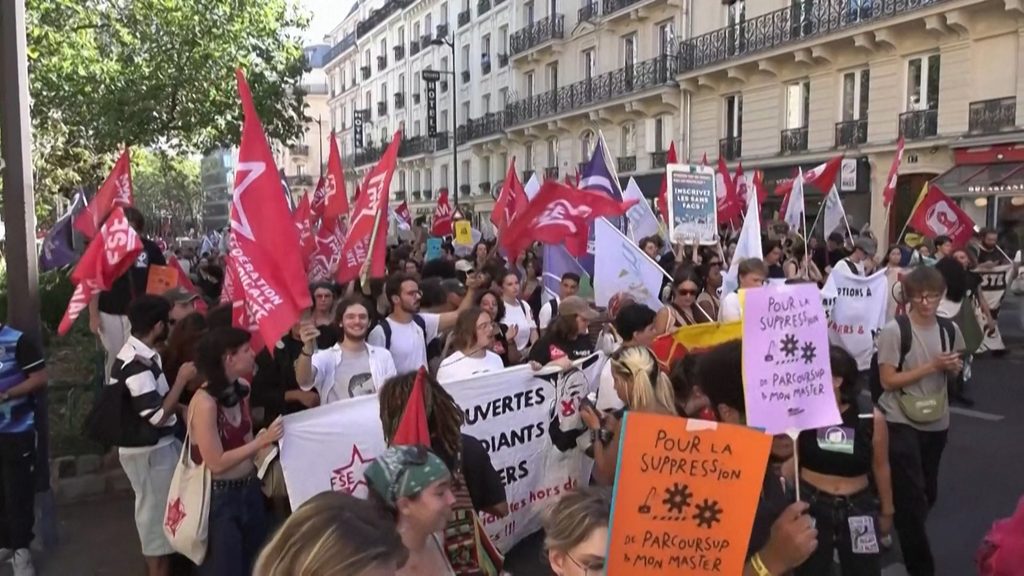
The protesters are therefore defending more than university budgets. Their demands touch on the broader question of whether higher education should remain widely accessible and adequately supported as France attempts to reduce public spending. For lecturers and researchers, investment also means protecting laboratories, academic jobs and the country’s ability to develop new knowledge and innovation.
The dispute comes at a difficult moment for France, where economic uncertainty is already forcing difficult choices over government spending. Debt-servicing costs are rising sharply, while the government is under pressure to reduce its deficit and prepare a credible budget for 2027.
The Paris demonstration could therefore become part of a wider debate over France’s priorities in the years ahead. The government faces the challenge of controlling public spending without weakening a higher-education system that supports social mobility, research and economic innovation. For the students and lecturers marching through the capital, the message is clear: investment in universities is not simply an expense, but a long-term investment in the country’s future.