
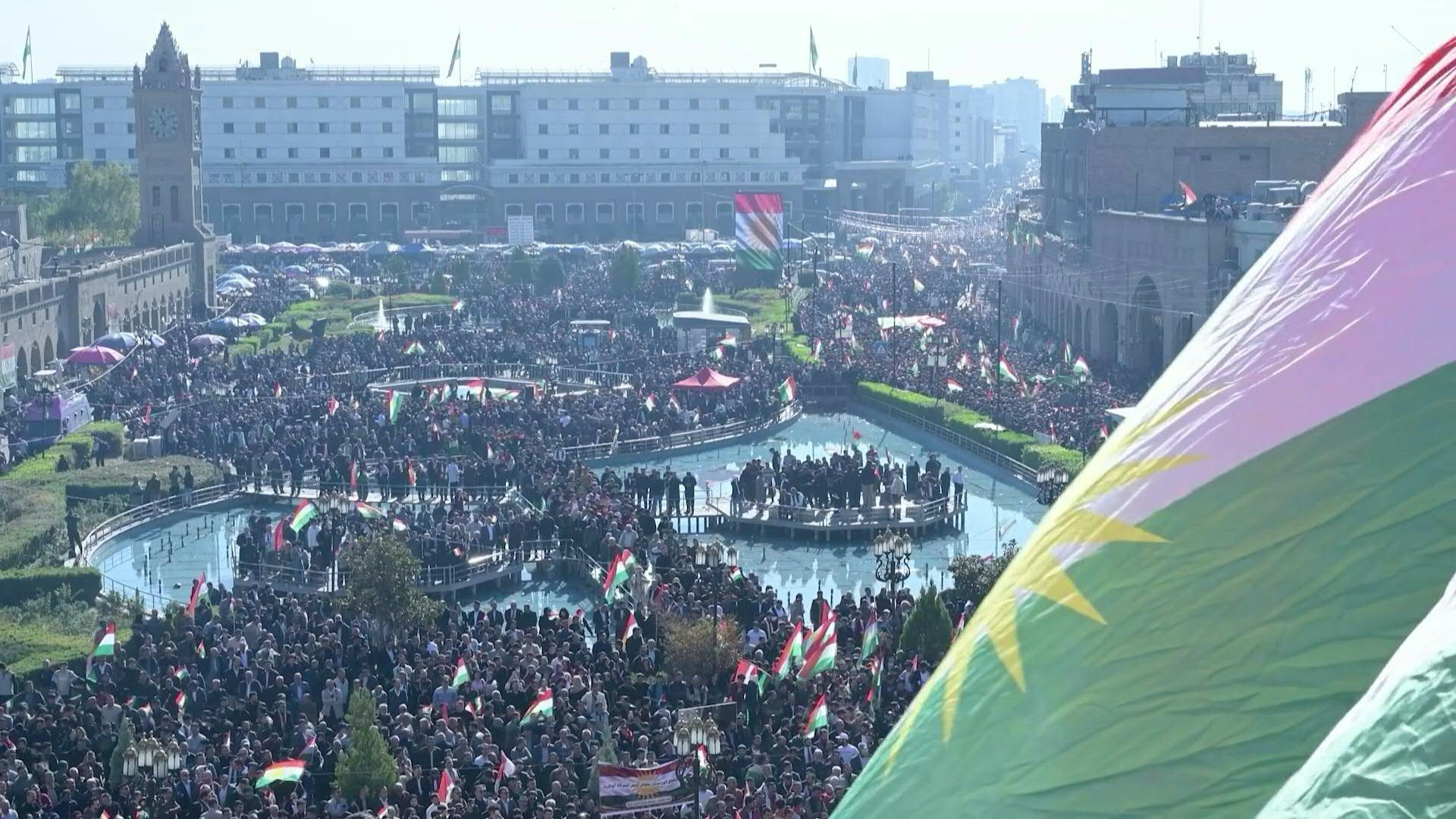
Thousands of protesters have taken to the streets in Iraq’s semi-autonomous Kurdistan region, waving Kurdish flags and demonstrating against the federal government’s efforts to take control of border crossings and oil fields previously administered by Kurdish authorities.
The demonstrations took place on Thursday, November 26, 2026, in Erbil, the regional capital, and other Kurdish cities, amid growing tensions over the constitutional status of the region and its right to govern its own affairs.
The protests followed orders by Iraqi Prime Minister Ali al-Zaidi directing federal authorities to assume control of border crossings in the Kurdish region, close unofficial routes suspected of facilitating oil smuggling and extend federal oversight over oil fields in several provinces.
Baghdad says the measures are intended to combat oil smuggling, protect national resources and strengthen government control over the country’s borders. However, Kurdish leaders have rejected the move, describing it as an infringement on the region’s constitutionally recognised autonomy.
The dispute escalated further on Wednesday after Iraq’s Federal Supreme Court ruled that the federal government had constitutional authority to deploy security forces along all of the country’s international borders, including those within the Kurdistan region.
The ruling also backed Baghdad’s authority to supervise border crossings and oversee oil and gas production, strengthening al-Zaidi’s position in the dispute.
The Kurdistan Regional Government (KRG), led by Prime Minister Masrour Barzani, condemned the decision, arguing that Baghdad’s actions violated the Iraqi constitution and threatened the powers granted to the region under the country’s federal system.
In a statement following a government meeting, the KRG expressed concern over what it described as military threats and rejected attempts to return Iraq to a centralised system of government. It called for dialogue and cooperation to address concerns about corruption and oil smuggling.
The disagreement reflects a longstanding struggle between Baghdad and Erbil over control of oil resources, disputed territories, border administration and the distribution of national revenue.
Iraq’s 2005 constitution formally recognised the Kurdistan region as an autonomous federal entity, allowing it to maintain its own regional government and security forces. However, disagreements over the interpretation of constitutional provisions governing oil and border management have repeatedly strained relations between the two administrations.
Meanwhile, Kurdish political representatives have called for negotiations to prevent the disagreement from escalating. Several parliamentary blocs were expected to meet with Iraqi political leaders to present proposals addressing the region’s autonomy, public-sector salaries and the implementation of constitutional provisions.
The United States has also offered to mediate between Baghdad and Erbil as concerns grow over the possibility of further confrontation.
The demonstrations mark another chapter in the long-running political and economic tensions between Iraq’s federal government and its Kurdish region, with the management of oil resources and the limits of regional autonomy at the centre of the dispute.