
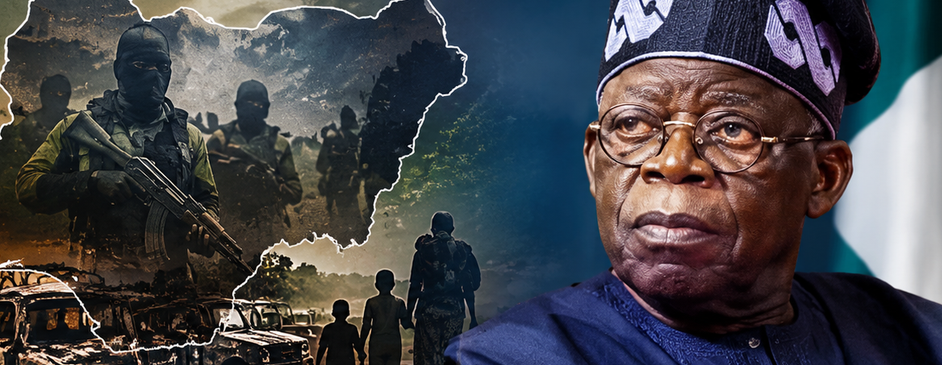
Senator Abdulaziz Yari’s recent defence of President Bola Tinubu over Nigeria’s persistent security challenges has brought renewed attention to the current administrations’ effforts towards to insecurity in the country.
Yari, Director-General of the All Progressives Congress (APC) Presidential Campaign Council, said the President should not be blamed solely for insecurity, noting that former President Muhammadu Buhari, a retired Army general, also was unable to completely eliminate the problem during his eight-year administration.
Speaking during a visit to Kebbi State on Monday, Yari maintained that Tinubu had done his best to address the country’s security challenges. His comments raise a broader question: what does the available evidence show about the government’s efforts and the security situation facing Nigerians today?
Security Operations and Reported Gains
There is evidence of ongoing military and security operations under the Tinubu administration.
According to the Defence Headquarters, troops neutralised 554 terrorists, arrested 1,333 suspects and rescued 1,736 kidnapped civilians during nationwide operations between July and September 2026. The military also reported the recovery of firearms and ammunition as part of the operations.
The figures, published by Voice of Nigeria on October 2, reflect the scale of security activity during the three-month period. However, they are operational figures released by the military and do not, on their own, establish the overall change in insecurity nationwide. A broader assessment would also require consistent data on attacks, civilian casualties, abductions and the safety of affected communities.
The Continuing Security Challenges
Despite ongoing operations, insecurity remains a concern in several parts of the country.
The National Human Rights Commission’s September 2026 Human Rights Situation Dashboard documented 208 killings and 210 kidnappings during the reporting period. The Commission said its dashboard draws on complaints received through its offices and incidents monitored by its Human Rights Observatory.
These figures provide an indication of the continuing human cost of violence. They should, however, be understood within the Commission’s monitoring framework and not treated as a complete count of every incident across Nigeria.
In August, a mass abduction in Niger State also prompted President Tinubu to order security agencies to launch rescue operations. The incident highlighted the continuing threat posed by armed groups in parts of the North-Central and North-West regions.
Taken together, the reports show that security agencies are conducting operations while communities continue to face serious threats. We cannot make logical assessments without examining both developments.
How Should the Government’s Record Be Measured?
A fair assessment of the Federal Government’s response requires more than the number of arrests, rescues or operations announced. It also requires examining whether attacks and kidnappings are declining, whether communities are becoming safer, and whether displaced residents can return home and resume their livelihoods.
Comparisons between administrations also need to account for the different periods, locations and forms of insecurity being measured. Buhari’s administration faced insurgency, banditry and mass kidnappings, while Tinubu’s government continues to confront these and other security threats. The fact that a challenge predates an administration is relevant context, but it does not replace an assessment of its actions and results while in office.
Consistent data from security agencies, humanitarian organisations and independent monitoring bodies can help provide a clearer picture of trends over time. Differences in reporting methods and coverage must also be considered before drawing conclusions.
Beyond Political Statements
Yari’s remarks reflect the position of a senior figure in the ruling party that the President’s efforts should be recognised. The available evidence confirms that security operations are ongoing, while official human-rights monitoring and recent incidents also show that significant challenges remain.
The central issue, therefore, is how these efforts translate into a secured state for the citizens. For Nigerians living in affected communities, progress is measured not only by official announcements but also by their ability to travel, attend school, farm, trade and sleep without fear.
A balanced assessment of the government’s record should recognise documented operations and rescues while continuing to examine security outcomes, gaps and the experiences of affected communities. Such an approach would enable focus on evidence, ensuring balanced security and results rather than political claims alone.