

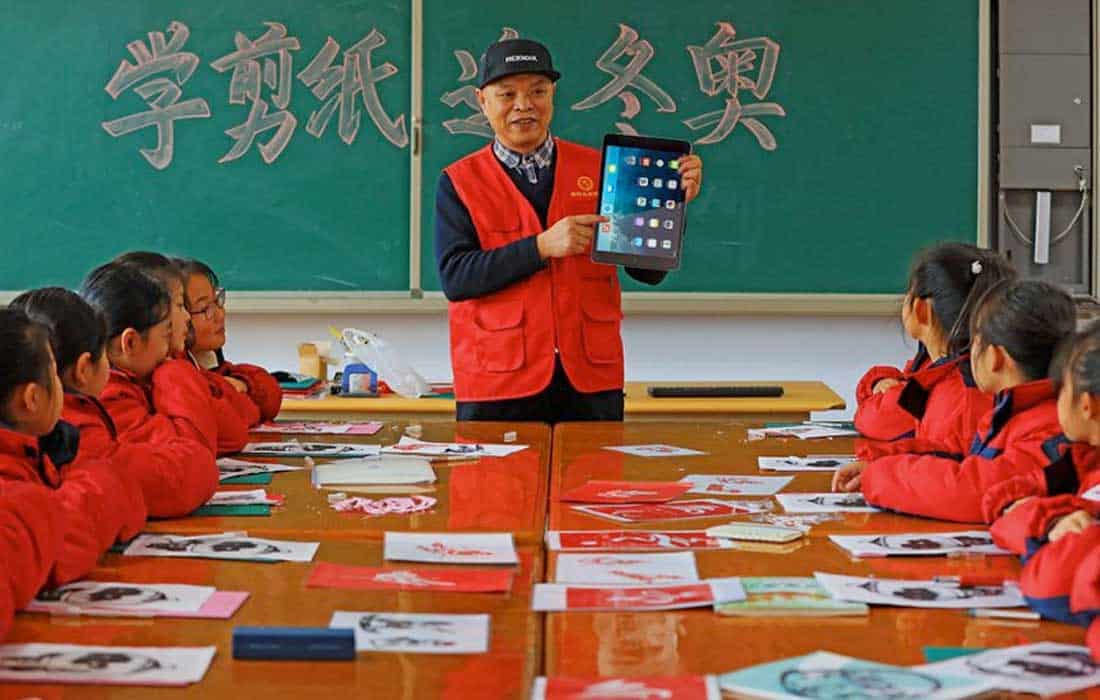
As Nigeria intensifies its digital economy drive to future-proof the next generation of youth, a dramatic shift in global educational benchmarks is unfolding in Asia. China has officially launched an unprecedented nationwide policy making artificial intelligence (AI) education fully mandatory for all primary and secondary school students, capturing children as young as six years old.
The new national curriculum
Backed by China’s Ministry of Education, this high-stakes initiative is a critical pillar of the country’s broader New Generation AI Development Plan. The policy ensures that every single student receives at least eight hours of structured AI instruction per year, embedding technological fluency directly into the national workforce pipeline.
AI education has now been elevated to a formal component of the national curriculum. Local school boards are integrating these modules into existing science and technology classes or deploying them as standalone, graded disciplines.
Tiered learning: From voice assistants to algorithm design
The national framework avoids abstract computing theories for younger pupils, focusing instead on highly interactive, age-appropriate exposure. The curriculum is meticulously structured across three distinct tiers aligned with cognitive development stages.
Elementary level (Ages 6–12)
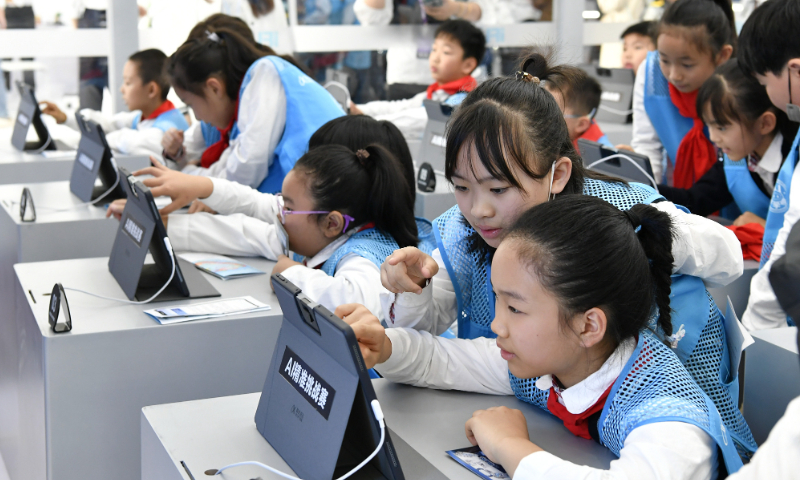
Lessons target basic AI literacy through hands-on experience with smart devices. Children are taught basic concepts like voice recognition using smart speakers, image classification, pattern recognition, and playful robotics to build early curiosity.
Junior high level (Ages 13–15)
Instruction pivots toward technical logic and ethics. Students examine active machine learning workflows, evaluate data algorithms, and develop the critical thinking skills required to identify misinformation in generative AI outputs.
High school level (Ages 16–18)
The final tier shifts entirely toward applied innovation and creation. Secondary students use their accumulated digital knowledge to design simple AI models, engage in advanced algorithm thinking, and execute interdisciplinary tech projects.

“We will build a general AI literacy system for all stages of education and for the whole of society,” stated Zhou Dawang, Director of the Chinese Ministry of Education’s Department of Science, Technology and Informatization, outlining the strategic imperative of universal access.
Context box: Fast facts on China’s mandatory AI curriculum
| Policy Attribute | Operational Specification |
| Commencement date | September 1, 2025 |
| Target demographic | All primary and secondary students (Ages 6 to 18) |
| Minimum instructional time | 8 class hours per academic year |
| Core strategy linkage | National “AI+ Initiative” and “New Productive Forces” |
| Primary educational focus | Progressive pipeline from basic familiarity to algorithmic creation |
Strategic ambitions and global repercussions
Beijing openly views artificial intelligence as the absolute core of future global power, national sovereignty, and economic competitiveness. By introducing these concepts in early childhood, the government intends to build a massive, early-trained domestic workforce capable of pioneering AI advancements for decades to come.
While advanced economies like England, South Korea, Canada, and parts of the United States have introduced localized AI training frameworks, China’s rollout stands as the largest coordinated digital education program in human history, covering hundreds of millions of children simultaneously.
Confronting cognitive and logistical risks
Despite the enthusiastic implementation, global educational experts have raised serious warnings regarding early, intensive exposure to automated systems. Psychologists warn of cognitive risks, noting that premature reliance on AI platforms could potentially weaken fundamental human problem-solving capabilities and critical logic.
Furthermore, social critics fear that an overreliance on generative AI tutors may drastically reduce essential peer-to-peer human interaction. Mechanically, the policy faces immediate logistical hurdles as school systems grapple with a severe shortage of teachers formally trained in AI, threatening to widen the quality gap between urban and rural institutions.
The social call-to-action (CTA)
How should Nigeria’s Ministry of Education approach the integration of artificial intelligence in our local school curriculum to protect and prepare our youth? Share your views on NTA’s digital platforms using the hashtag #NTADigitalInnovation.