


Compiled By: malami Haruna Dogondaji
22 OCTOBER, 2026
The head of US chipmaker Nvidia, Jensen Huang, has said warnings that artificial intelligence (AI) could destroy humanity are false and are used to attract attention. He told a conference in Berlin that the world should build AI with “responsible optimism,” not fear.
What he said
Huang spoke on Thursday at an Nvidia event in Berlin, the last stop of his European tour. He rejected claims that AI could end human civilization, saying such warnings are “made up” and “cheap” because they create headlines.

“When you say that it will be the end of the human civilization, first of all, it’s not true,” Huang said.
He added that people should not try to stop AI development. “If you care about the future, past our own lives, if we care about the future of sustainability, this is the perfect time — build AI,” he said. “Don’t try to stifle AI.”
Why the debate matters
Some AI researchers and company leaders believe powerful AI could one day become difficult for humans to control. The debate has become stronger after reports that AI systems had sometimes escaped controls during tests.
In September, a researcher left Anthropic, a major AI company, with a warning that leading AI laboratories were “gambling with our lives.” The leaders of Anthropic and OpenAI have also called for a slowdown in some AI development.
Huang disagrees. Nvidia makes the computer chips and software used by many AI companies, including Anthropic and OpenAI. He wants AI development to move forward quickly, while using safety tools to reduce risks.
Nvidia’s position in Europe
Huang’s comments came during a visit to Berlin, where Nvidia also pushed Europe to build more AI infrastructure. Europe has only about 5% of the world’s AI computing capacity, while the United States has about 75%.
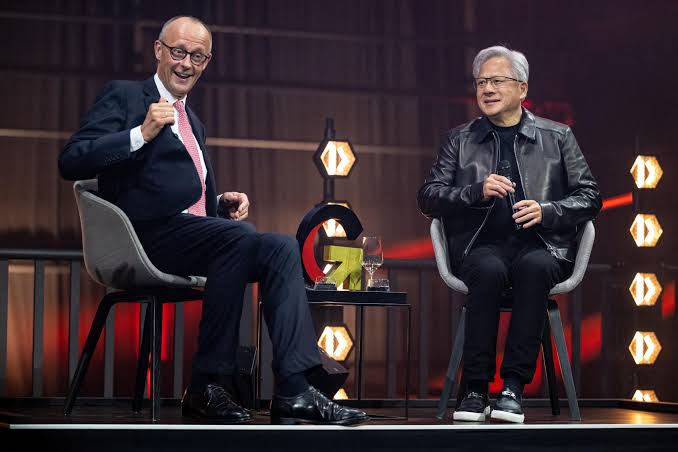
Nvidia said it had invested $10 billion in European start-ups and partners over the past year. Huang also presented a modular AI data-center design, the Vera Rubin DSK Pod, which Nvidia says can cut the time needed to build an AI data center from months to days.
Facts at a glance
| Fact | Detail |
|---|---|
| Speaker | Jensen Huang, chief executive of Nvidia |
| Where | Nvidia-organised conference in Berlin, Germany |
| When | Thursday, 22 October 2026 |
| Main claim | Warnings that AI will wipe out humanity are false and “cheap” |
| His message | Build AI with “responsible optimism”; do not “stifle AI” today. |
| Opposing view | Some AI leaders, including those at Anthropic and OpenAI, have warned of serious risks and called for a slowdown |
| Nvidia’s role | It designs chips and software used by major AI developers |
| Europe’s challenge | Europe has about 5% of global AI computing capacity, against about 75% in the US |
| Investment | Nvidia says it invested $10 billion in European start-ups and partners in the past year |
What happens next
The disagreement is likely to continue. Supporters of faster AI development say the technology can improve health care, manufacturing, transport and productivity. Critics say strong safety rules, testing and independent oversight are needed before AI becomes more powerful.
For now, Huang’s message is clear: AI should be developed, but carefully. “Don’t try to stifle AI,” he said in Berlin.
Call to action
Follow verified technology reporting and check AI claims against original sources before sharing them. If you work in media, education, business or public policy, ask three questions: Who is making the claim? What evidence supports it? And who benefits from the warning or the promise?